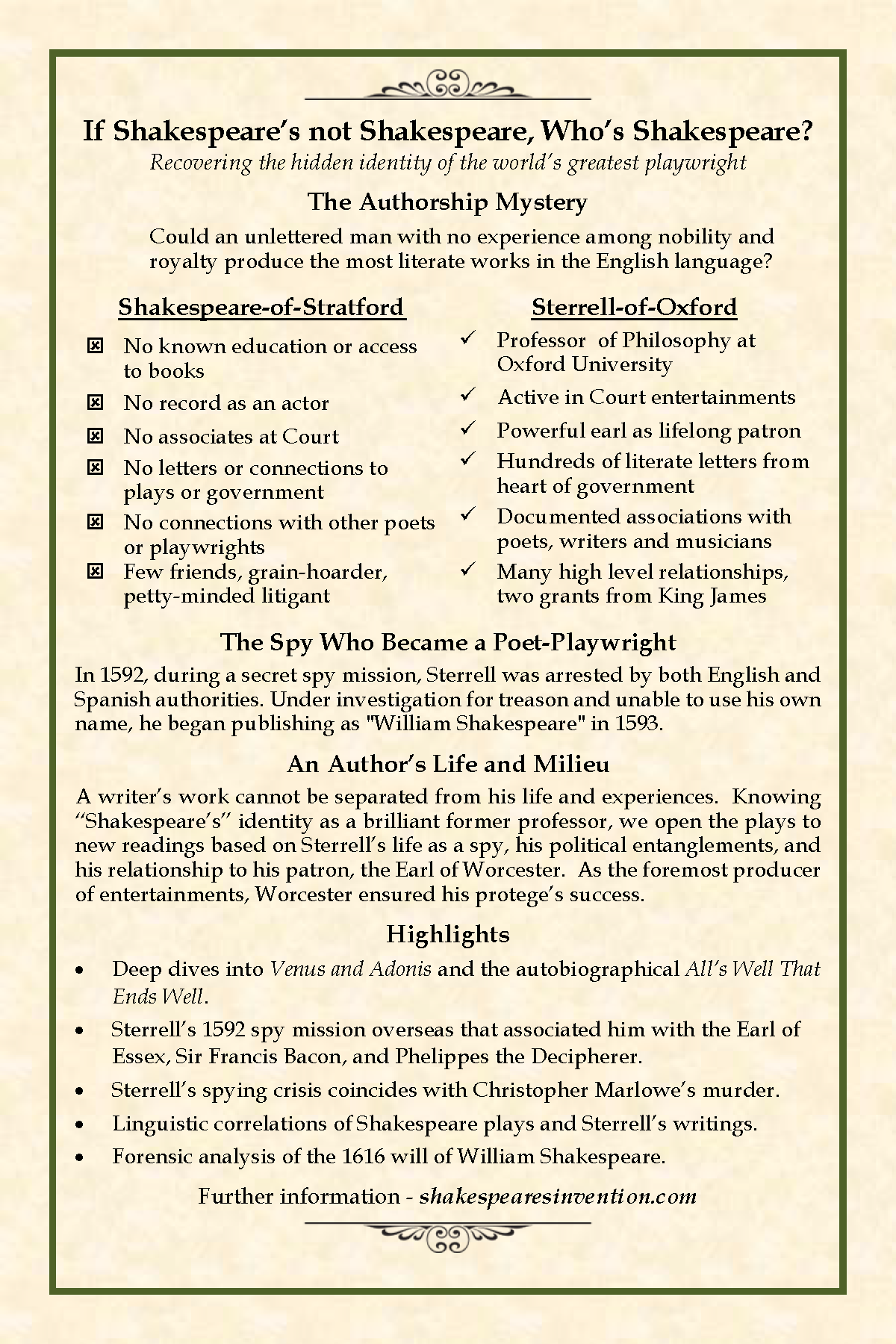
“I” Shakespeare
Poor Shakespeare! No one will take him at his word. His poetry and plays have been pored over for centuries. Every scrap of paper in records, every reference to him, every rumor has been tracked down. Yet the only times he has spoken directly about himself, using “I” in his poetry (but never in the plays), he has been ignored.
The fixed stars of written Shakespeare are the two long poems of 1593-1594, Venus and Adonis and Lucrece. Both are dedicated to the Earl of Southampton. Generally accepted as authentic Shakespeare also are the enigmatic Phoenix and Turtle (1601) and Shake-speares Sonnets (1609). Neither has explicit endorsement by the author. We know nothing directly about any other connection between the writer Shakespeare and a single play or writing of any sort. Only these four works carry authenticity. Yet they are ignored for their hints, their implicit statements, that the name Shakespeare is not the name of the poet/author. Let’s listen to him, even if no one else will.
The love epic Venus and Adonis was published in late May 1593. Dedicated to the Earl of Southampton, it states that the poem is “the first heir of my invention.” The Shakespeare industry insists this can’t be true because by 1592 Shakespeare was already known as a playwright. What a curious way to seek patronage: you tell the potential patron he is the first person to receive your precious gift while others already know you as an author. Surely the patron would be offended. So, Shakespeare scholars dismiss the words of the dedication.
In Sonnet 81 the poet speaks in the first person when he says:
Your name from hence immortal life shall have,
Though I (once gone) to all the world must die,
The earth can yield me but a common grave,
If the name Shakespeare will have immortal life, then the “I” and “me” must not be named Shakespeare. The same thought is repeated in Sonnet 107 when the poet says that after he dies, “I'll live in this poor rhyme.” He tells the close friend, “thou in this shalt find thy monument,” repeating Sonnet 81’s notion of the sonnets being a monument. The poet and the “thou” cannot be the same person; one lives by virtue of the rhyme and the other by “this,” which is the sonnet or the collection of sonnets that bear only the one name. If it is Shakespeare’s name (and there is no other name anywhere in the book) that is to be immortal and to have a monument in the sonnet(s), who is the “I” of the sonnets? It must the real poet. Does not the poet playfully hint to us?
Sonnet 76 gives us a puzzle:
Why is my verse so barren of new pride?
So far from variation or quick change? . . .
That every word doth almost tell my name
How can barren verse, lacking variation or quick change, tell the poet’s name? It is exceptionally difficult to eke an allusion to the name “Shakespeare” by any of these words. Does he not suggest his name is the same as barren – saying “barren doth almost say” his name because it is sterile/Sterrell? Does he not make the same suggestion in Sonnet 16 when he speaks of his “barren rhyme”? Barren” and “Sterile”(Sterrell’s homonym) are that rare thing that a linguist would call “total [or absolute] synonymy.”